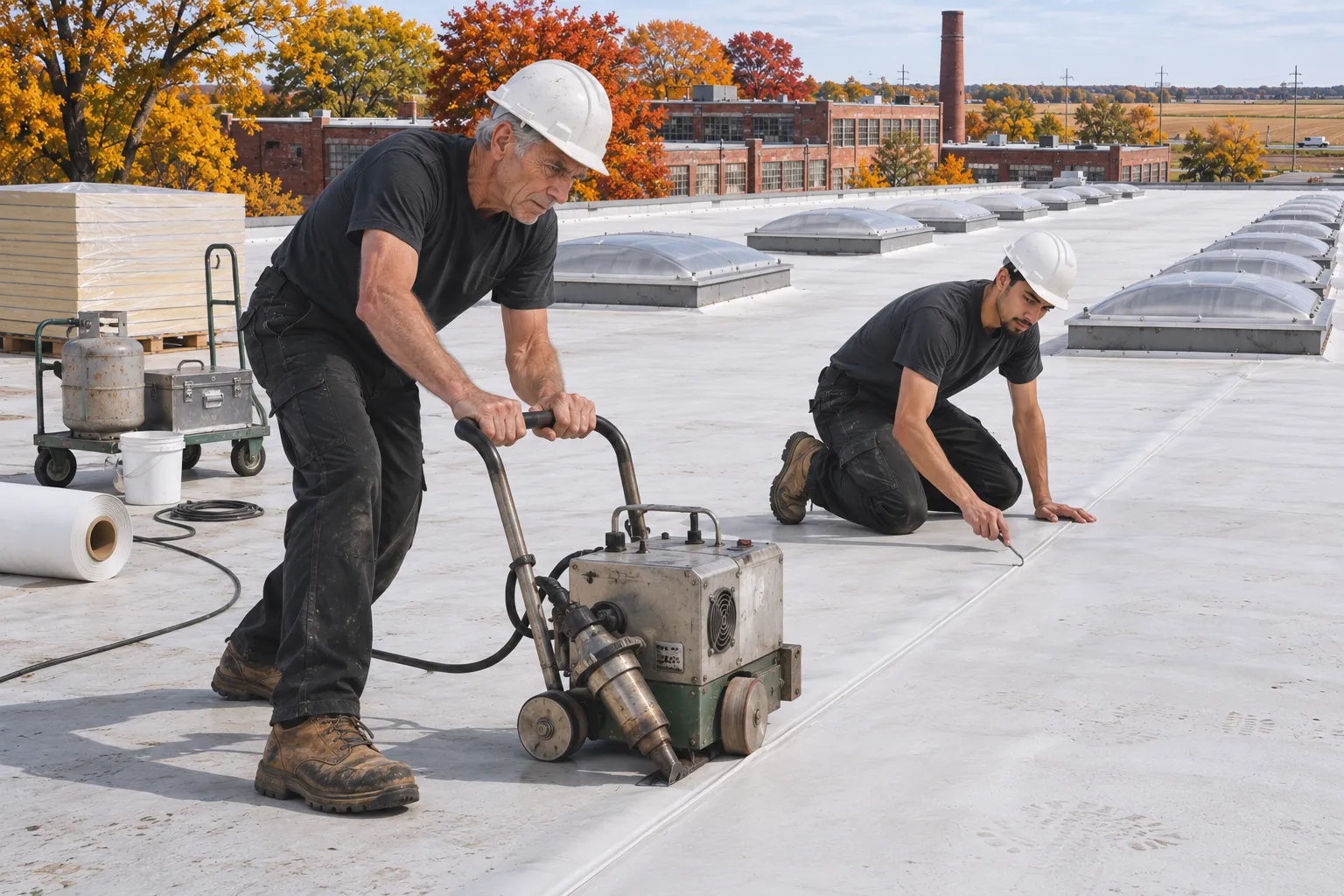
Roofer heat-welding a TPO membrane seam with a hand welder

Commercial Roofing Questions in Muncie

Straight Answers on Systems, Cost, Weather, and Permits

These commercial roofing questions in Muncie come from building owners and facility managers, answered plainly with what drives each decision.

Commercial Roofing Questions in Muncie by Topic

Pick a topic. Every answer to these commercial roofing questions in Muncie is written for business, industrial, and farm buildings.

Commercial Roofing in Muncie Questions

What commercial roofing systems do you install in Muncie?

We install TPO and EPDM single-ply roofs, industrial roofing systems, and commercial metal roofing on business and industrial buildings in Muncie. The right system depends on the roof's slope, the deck and insulation underneath, rooftop equipment, and how the building is used. We inspect first and explain why one system fits better than another.

What should I ask a commercial roofing company near Muncie before hiring?

Ask what roof system they recommend and why, whether the old roof will be torn off or covered, how insulation and flashing will be handled, and how they will work around your business. For Muncie buildings, also ask how they handle weather delays. A written scope that answers these questions makes proposals easier to compare.

What roof systems fit Muncie medical office buildings?

Muncie medical office buildings often have low-slope roofs with many rooftop air handlers, so TPO or EPDM with good flashing at every curb is a common fit. We schedule noisy and odor-producing work away from patient hours where possible, protect air intakes, and keep entrances clear. Sloped roof sections may suit metal panels.

What roofing works for Muncie retail centers?

Retail centers in Muncie usually have long, low-slope roofs over several tenants, with rooftop units, parapets, and drains along the back. TPO and EPDM suit these roofs well.

We plan work by tenant section, keep storefronts and parking open, and pay close attention to drainage, since ponding behind parapets is a common problem on retail roofs.

Cost and Replacement Questions

What drives commercial roofing cost per square foot in Muncie?

We do not give per-square-foot prices before seeing the roof. In Muncie, cost depends on the roof system, insulation thickness, how many old layers come off, wet insulation to remove, deck repairs, roof height and access, and the number of curbs, drains, and penetrations.

A free on-site estimate measures the roof and checks its condition, and that sets the price.

What affects commercial roof replacement cost for a Muncie building?

Replacement cost depends on the size and shape of the roof, the system chosen, tear-off layers, wet insulation and damaged decking, new insulation requirements, flashing at walls and equipment, and access for cranes and dumpsters.

For a Muncie building, a free on-site estimate with moisture readings sets the price, so you know what is included before work starts.

Can a Muncie commercial roof be replaced during winter?

Yes. Commercial roofs in Muncie can be replaced in winter with planning. We remove snow and ice from the work area, dry the deck, use cold-rated adhesives or mechanical fastening, and close each section before the end of the day.

Snowstorms pause the work, so winter schedules allow extra time, but leaks and failing roofs do not need to wait for spring.

TPO Roofing Questions

How does TPO roofing perform in Muncie cold weather?

TPO stays flexible enough in cold weather to handle normal winter movement, and its heat-welded seams do not depend on glue that cold can weaken.

During installation in Muncie winters, frost, snow, and adhesive temperature limits are the main concerns. We dry the deck, choose cold-rated products, and close each section before the end of the workday.

Can a TPO roof last 30 years on a Muncie building?

Some do, but lifespan depends on membrane thickness, installation quality, drainage, and maintenance. On Muncie buildings, ponding water, hail, and foot traffic to rooftop units wear TPO faster.

TPO roofs are often expected to last around 20 to 30 years with regular inspections and prompt repairs. Thicker membranes and good drainage help a roof reach the longer end.

What are the downsides of TPO roofing on Muncie commercial roofs?

TPO's weak points are its seams, which depend on careful welding; its surface, which can be punctured by dropped tools or hail; and its slippery surface when wet or frosty.

Quality also varies between manufacturers. On Muncie commercial roofs we test seams, add walkway pads at service routes, and choose a membrane thickness matched to the building's traffic.

TPO vs EPDM: which roof fits a Muncie building better?

Both work well on low-slope roofs. White TPO reflects summer heat and has heat-welded seams, while black EPDM is flexible in cold weather and has a long track record.

For Muncie buildings, TPO often suits roofs with heavy cooling loads, and EPDM suits roofs where flexibility and simple repairs matter. The deck, insulation, and rooftop equipment also guide the choice.

How does spring hail damage commercial roofs in Muncie?

Hail can puncture or bruise single-ply membranes, fracture aged seams, crush insulation under the membrane, and dent metal panels. On Muncie roofs, much of that damage is hard to see from the ground. A roof walk after a hailstorm finds it, and photos taken then help if the owner files an insurance claim.

EPDM Roofing Questions

How does EPDM handle freeze-thaw cycles on Muncie roofs?

EPDM rubber stays flexible in the cold, so the membrane handles freeze-thaw well. The weak points on Muncie EPDM roofs are seams, flashing, and low spots.

Water that gets into an open seam freezes and widens it, and ice at drains backs water up under flashing. Keeping seams sealed and drains clear matters more than the rubber itself.

What is the average lifespan of an EPDM roof in Muncie?

An EPDM roof is often expected to last around 20 to 30 years, depending on membrane thickness, how it is attached, and how well it is maintained.

On Muncie roofs, seam condition, flashing at walls and curbs, and ponding water usually decide its life. Regular inspections and early seam repairs help, while neglected drains and heavy foot traffic shorten it.

What problems show up most often on Muncie EPDM roofs?

The most common problems are opened seams, membrane shrinkage that pulls flashing away from walls and curbs, punctures from foot traffic and debris, and ponding near drains. On Muncie roofs, freeze-thaw and snowmelt make each of these worse. Catching them early, before water soaks the insulation, keeps repairs small.

Fully adhered or ballasted EPDM: which suits a Muncie building?

Fully adhered EPDM is glued to the insulation or cover board, which gives a smooth, wind-resistant roof that is easy to inspect and repair.

Ballasted EPDM is held down by stone, which installs quickly but adds weight and hides the membrane. For Muncie buildings, the roof structure's capacity, wind exposure, and how often crews walk the roof decide which fits.

How does summer heat affect Muncie flat roofs?

Summer heat makes membranes expand and slowly dries out sealants and adhesives. Black EPDM absorbs more heat, while white TPO reflects much of it and can lower rooftop temperatures.

On Muncie flat roofs, heat stress shows up first at seams, flashing, and around rooftop units, which is why those areas get the most attention during inspections.

Have a Question Not Covered Here?

Call and ask it. We will answer on the phone or, if the roof needs a look, during a free roof walk.

Industrial Roofing Questions

Why do walkway pads matter on Muncie manufacturing plant roofs?

Walkway pads protect the membrane on the paths maintenance crews walk to reach fans, HVAC units, and process equipment. On Muncie manufacturing plant roofs, repeated foot traffic and dropped parts wear through membranes and cause leaks. Pads spread the load and mark a clear route from the roof hatch to each unit.

What industrial roofing materials work on Muncie facilities?

Muncie industrial facilities typically use TPO or EPDM membranes on low-slope areas and commercial metal panels on sloped sections, over rigid insulation and cover boards. Material choice depends on heat or chemicals from process exhaust, rooftop traffic, the deck, and drainage. We match the system to the conditions the roof sees every day.

How do you roof around rooftop equipment on Muncie industrial buildings?

Every curb, pipe, and support is flashed so water cannot get under the membrane. On Muncie industrial buildings, we raise curbs that are too low, install pipe boots and support pads, and leave service clearance around units. When equipment must be lifted or disconnected, we coordinate with the facility's mechanical contractor ahead of time.

When does a Muncie industrial roof need replacement instead of repair?

Replacement is usually the better choice when leaks are widespread, insulation is wet over large areas, the membrane is brittle or shrinking everywhere, or repairs keep failing.

On Muncie industrial roofs, moisture surveys and core samples show how much of the roof is still sound. We plan replacements in phases around production when the plant cannot shut down.

What roofing works on Muncie plants with heavy rooftop exhaust?

Plants with heavy exhaust need a membrane that resists the heat, oils, or chemicals coming out of their fans and vents.

On Muncie plants, we identify what the exhaust carries, then choose a compatible membrane and add protection around the fans. Grease and process residue break down some membranes quickly, so material choice matters more than on a typical roof.

Commercial Metal Roofing Questions

What is retrofit framing for a Muncie metal roof?

Retrofit framing is a light steel framework installed over an existing flat roof so new metal panels can sit on top with real slope.

On Muncie buildings it improves drainage, makes room for insulation, and often avoids a full tear-off. The structure must be checked to carry the added weight, and the framing design usually needs an engineer.

What are the biggest problems with metal roofs on Muncie buildings?

The biggest problems are loose fasteners, opened laps, rust at cut edges and low spots, and leaks around skylights, curbs, and gutters. On Muncie buildings, freeze-thaw movement loosens fasteners faster, and condensation can drip from the underside of panels in unheated buildings. A roof inspection finds most of these before they spread.

Standing seam or exposed fastener: which metal roof suits a Muncie commercial building?

Standing seam panels hide their fasteners under raised seams, which removes most screw leaks and lets panels move with temperature. Exposed fastener panels cost less up front but need fastener maintenance over the years.

On Muncie commercial buildings, standing seam often suits low-slope and long roofs, while exposed fastener panels are common on shops and storage buildings.

Do you install metal roofing on agricultural buildings around Muncie?

Yes, we install commercial metal roofing on agricultural buildings around Muncie, including equipment storage, shops, and farm operations buildings. We check framing and purlin spacing, recommend panel type and gauge, and add ventilation or a condensation control layer where needed, since livestock and unheated storage buildings often have moisture under the roof.

How does snow affect commercial roofs on Muncie buildings?

Snow adds weight and drifts against parapets, walls, and taller roof sections, and melting snow refreezes at drains and gutters. On Muncie buildings, that can stress older framing and back water up under flashing. We check drainage and flashing heights during inspections, and any structural concerns about snow weight should go to a structural engineer.

Permits and Codes Questions

Do I need a permit for commercial roofing in Muncie, IN?

Check with the City of Muncie's Office of the Building Commissioner, which handles building permits in the city; its permit application lists roof work as a project type.

Commercial buildings in Indiana fall under the Indiana Building Code, adopted by the Fire Prevention and Building Safety Commission in 675 IAC 13. We confirm permit needs for your scope before work begins.

Towns We Serve Questions

Do you install commercial roofs in New Castle?

Yes, we install TPO, EPDM, industrial, and commercial metal roofs on business and industrial buildings in New Castle. Every project starts with a roof walk and moisture readings. We then recommend the system that fits the building's slope, use, and deck and explain the full scope before work begins.

Can you replace a commercial roof in Yorktown while the business stays open?

In Yorktown we work in sections, stage materials away from entrances, and close each section by the end of the day so the building stays dry and open. Noisy tear-off and crane lifts are scheduled with the owner ahead of time to limit disruption to customers and staff.

Do you install metal roofs on Decatur commercial and farm buildings?

We install commercial metal roofing on businesses, shops, and agricultural buildings in Decatur. We help owners choose between standing seam and exposed fastener panels and check framing first so the new roof sits on a sound structure. Ventilation is part of the plan on buildings prone to condensation.

What roofing options fit Portland industrial buildings?

Portland industrial buildings often have large low-slope roofs that suit TPO or EPDM, plus metal roofs on sloped sections and additions. We check deck condition, insulation, and rooftop equipment before recommending a system, and explain whether the existing roof can stay in place under a new one or needs a full tear-off.

Do you replace flat roofs on Gas City commercial buildings?

Flat and low-slope roofs on commercial buildings in Gas City are replaced with TPO or EPDM. The work includes removing wet layers, repairing damaged decking, adding insulation, and flashing every wall, curb, and drain. We also look for ways to improve drainage during the replacement.

Get Answers to Commercial Roofing Questions in Muncie

Call with your question, or request a free estimate and ask it during the roof walk.

Call (317) 953-5970